
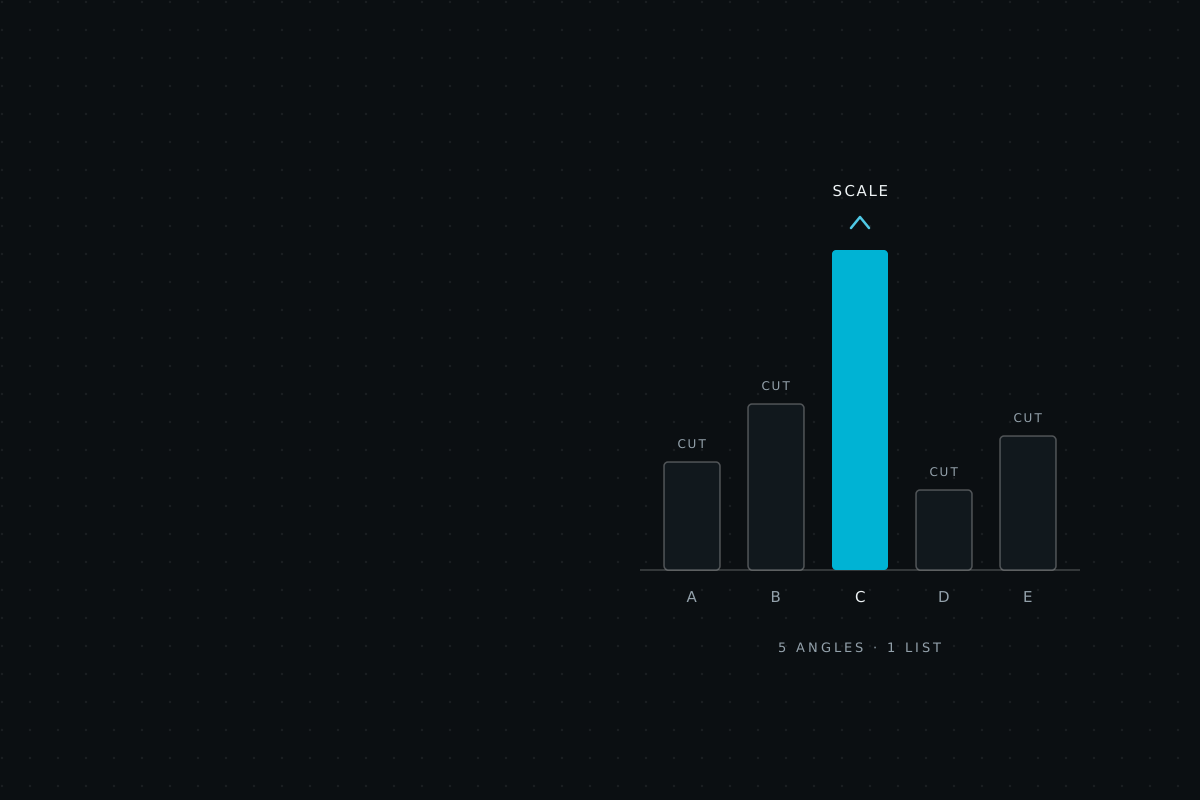
If you ran ads on Meta, you would never make one ad, throw your whole budget at it, and then decide advertising is a waste of money. Media buyers would laugh. They test a bunch of creatives and put more spend behind the ones people actually click. The ones that flop get cut.
So I don't get why so many people write one cold email, send it to their whole list, and then go, yeah, cold email doesn't work for me.
I test cold emails the same way a media buyer tests ads.
This post goes with my video "I Test Cold Emails Like Meta Ads (Here's the System)" on my YouTube channel. The video is the walkthrough. This is the written version you can come back to.
The problem: one email, one shot
Most cold email setups look the same. You sit down, write a sequence, maybe a first email and a follow-up, and you feel pretty good about it. Then you upload your list and you hit send.
And that's the whole test. One version, to the entire list.
If the replies are weak, you start guessing. Maybe the list was bad. Maybe the offer isn't strong enough. Maybe Monday was a bad day to send. I've said a couple of those myself.
All you actually learned is that one email, sent to that one list, at that one moment, didn't do what you wanted. You have no idea if a different opening would have done better, because you never sent a different opening.
People will spend an afternoon rewriting the same email to make it "better," or they'll change a word and send it again. They still have no idea what moved the needle, because they changed five things at once, or they changed nothing and just hoped harder.
Media buyers don't fall in love with one ad. They put versions in front of the market and they let the market talk.
The ad buyer mindset
This is the part I want you to steal.
A media buyer looks at an ad account in a pretty specific way, and it maps onto cold email almost one for one.
The email itself is the creative. It's the thing people see. The angle is the hook. It's the reason someone should care in the first two lines. And the list is the audience. It's who you're putting that creative in front of.
You stop treating your first draft like it's precious. That first email you wrote is version one. That's all it is. It might be good. It might be mid. You don't know yet, and your opinion is the least useful data point in the room. The people on the list decide, by replying or by ignoring you.
You also start testing cheap. You don't take your whole list and bet it on one version. You take a small slice, you send a few different angles, and you wait. The versions that get ignored, you kill. The version that gets the replies you actually want is the one that earns more volume.
Killing losers fast is the part people struggle with, because they wrote the email and they like it. I get it. I like my own writing too. Liking it doesn't mean it works. If an angle is dead, let it die and write a new one.
Nothing in your sequence is sacred. The angle can change. So can the offer line, the subject line, even the follow-up. The process is what stays. You test, you cut, you put more send volume behind the winner, and then you test again.
What to test, and in what order
Start with the angle. That's the biggest lever. If the angle is wrong, a prettier subject line will not save it. You'll just have a well-written email about something they don't care about.
Here are made-up example lines, not emails from a real campaign. You'd rewrite them in your voice, for your offer.
Angle 1Pain
First, a pain angle. You name the thing that's already annoying them. Something like:
"Most owners I talk to are still writing every cold email themselves, and the second they get busy with client work, the pipeline just stops."
Angle 2Result
Second, a result angle, the kind people sometimes call a case study angle. You point at an outcome. An example would be:
"I help small businesses set up outbound so intro calls keep coming in even when the founder is stuck in delivery all week."
If you have a real result from your own work, use that. Don't invent one.
Angle 3Trigger
Third, a trigger angle. Something changed at their company, and you noticed. Hiring is a classic one. An example:
"Saw you guys are hiring for a sales role, which usually means the founder is still doing a chunk of the outreach and it's getting to be too much."
Angle 4Curiosity question
Fourth, a curiosity question. You ask something that's easy to answer and hard to ignore. Example:
"Quick question, are you still sending cold emails one by one, or do you already have a system handling it?"
Angle 5Straight offer
And fifth, a straight offer. You just say what you do and ask for the call. Example:
"I build outbound systems for small businesses. If you want, I can show you how I'd set one up for yours on a short call."
See how different those are? You're testing which reason to care even gets a reaction. Commas can wait.
After the angle, I test the offer or the CTA. Same angle, different ask. Maybe one version asks for a 15-minute call, and another just asks if they want to see a short teardown of their outbound.
Then I test subject lines. They matter, but less than people think. A great subject line on a weak angle still leaves you with a weak email that got opened. I leave subject lines until the angle is settled.
Copy details come last. Word choice, a tighter first sentence, swapping a line. Do that after you know the angle is right. Otherwise you're polishing a version that was never going to win.
The order I test in
- 1
- The angle
- Biggest lever
- 2
- The offer or CTA
- Same angle, new ask
- 3
- Subject lines
- Once the angle is settled
- 4
- Copy details
- Last
How to run the test
Use one list. Split it into equal batches, one batch per variant. Same kind of lead in every batch. If one version goes to owners at 10-person companies and the other goes to directors at 200-person companies, you didn't test the email. You tested the list, and you won't know it.
Change one variable at a time. If you're testing angles, keep the subject line style in the same family, keep the CTA the same, and keep the follow-up structure the same. You're trying to learn which angle won. You can't learn that if three things moved at once.
Keep the sends small at the start. I aim for about 1,000 sends per variant. That's enough that a couple of random replies can't fool you, and not so many that you've burned the list on a loser. Once you have a winner, that's when the volume goes up. A system like this can get to 15K to 30K sends a month once you're putting volume behind what's working.
And keep everything else the same. Same sending domains, same days, same inbox warmup, same follow-up timing. I've seen people "test" two emails and also switch tools the same week, or finally start verifying the list mid-test. Then they pick a winner and they're really just celebrating a cleaner list.
If you're using Instantly, you set up the variants, split the list, let them run, and leave them alone. Don't rewrite a variant mid-test because you got nervous. That's like turning off an ad after two hours.
Write the variants before you start sending. If you write version two after version one already went out, you're going to "improve" it based on a feeling, and you'll sneak in little changes you can't track. Sit down, write all of them, then start the test.
Reading the results
I don't judge a test on open rates. Opens are messy now. Apple Mail and a bunch of other inboxes prefetch or automatically load pixels, so a lot of "opens" never came from a human actually reading the email. I would not pick a winner off them.
I look at positive replies, and I look at calls booked. A positive reply is someone who sounds actually interested, or at least open to a conversation. An "unsubscribe," a "not a fit," or a mean one-liner still counts as a reply. Total reply rate can lie to you if one version just made people more annoyed.
Give the test enough sends before you call a winner. A couple of replies on a small sample can be luck. One version gets two nice replies early, you panic and kill the others, and maybe you just got lucky on a Tuesday. Let it run until the difference is boring and obvious, or until it's clear they're basically tied. If they're tied, keep the one that's easier to scale, or keep both and test a new challenger against them.
And don't overreact to one weird thread. One person who loves it, or one person who hates it, is not a test result. It's one person.
Scaling the winner
Once you have a winner, the job changes. You stop spreading volume evenly, and you give the winner the list. That's the whole reason you ran the test.
Then you keep going. The winner is the champion, not the retirement plan. Every week or so, write a new angle and test it against the current champion. Keep the batches fair. If the new one loses, you still have your champion and you only spent a small slice learning that. If the new one wins, it becomes the new champion and you move the volume over.
That's how ad accounts stay good over time. People get tired of the same creative, and your list changes. A message that won two months ago can go quiet, and you won't notice if you never put a challenger next to it.
Your best email is probably one you haven't written yet. That's a good thing. It means you can still find it.